Explore the future of car rental in 2026, from AI and digital booking to connected vehicles, electric mobility, and travel trends through 2030.
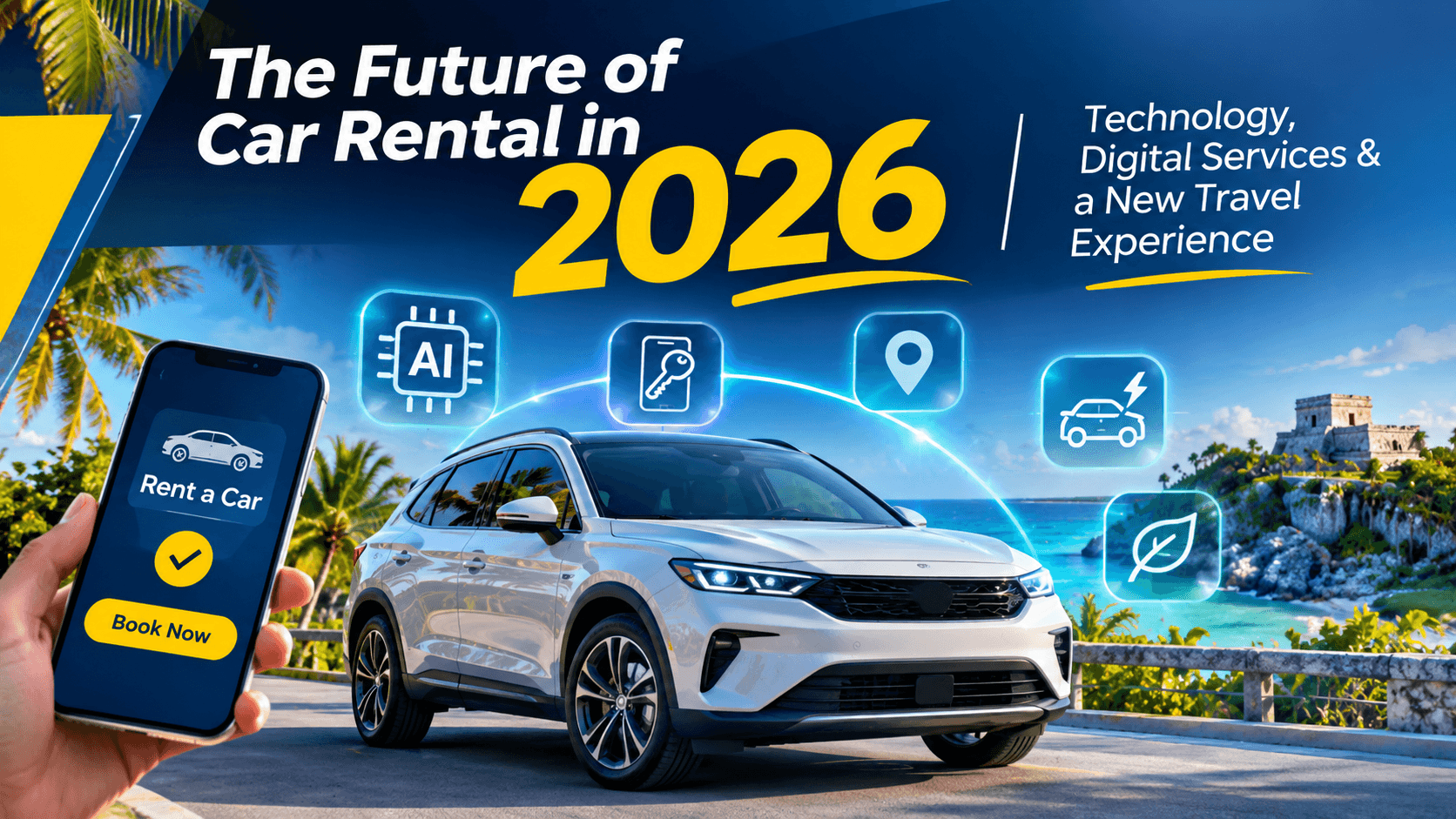
The Future of Car Rental in 2026
Technology, Digital Services & a New Travel Experience
Discover how artificial intelligence, mobile reservations, connected vehicles and digital innovation are reshaping the global car rental industry—and what these developments mean for travelers planning their next journey in Mexico.

Car Rental Is Entering a New Digital Era
Renting a car is no longer just about selecting a vehicle and collecting the keys. In 2026, the industry is increasingly focused on convenient digital experiences, clearer information, operational efficiency and the right balance between automation and personalized customer assistance.
Of Expedia survey respondents were at least somewhat likely to book multiple trip elements on one platform.
Of IATA survey respondents had used artificial intelligence for travel planning.
Of Expedia survey respondents said rental cars make it easier to experience destinations like a local.
Sources: Expedia Group Full Trip Planning Research, June 2, 2026; IATA Global Passenger Survey, October 28, 2026. Figures describe different surveyed populations and are not car rental industry adoption rates.
A New Chapter for the Car Rental Industry
The global car rental industry is undergoing a transformation that extends far beyond vehicle selection. Digital platforms, changing customer expectations and new operational technologies are influencing how rental companies communicate with travelers, organize their fleets and deliver transportation services.
In the past, renting a vehicle often required extensive interaction at a physical branch. Travelers might need to ask about vehicle availability by telephone, complete documents at a counter and clarify rental conditions only after arriving.
Today, online research and digital reservation systems allow customers to prepare for many of these decisions in advance. Depending on the provider, travelers may be able to compare categories, review policies, receive confirmations and complete certain administrative steps before vehicle collection.
Why Is This Happening Now?
Rental operators face changing expectations alongside fleet costs, financing pressures and competition from other mobility services. Technology can help improve operational processes, but the customer experience remains a central priority.
Euromonitor International's October 2026 analysis identifies the combination of digital efficiency and accessible human support as an important direction for the industry.
The Transformation in Three Dimensions
Customer Experience
Simpler access to reservations, information and communication.
Operations
Digital fleet management, administrative tools and coordination.
Customer Trust
Transparent conditions and dependable support when needed.
From Traditional Rental Counters to Connected Digital Experiences
Digital transformation involves redesigning how information and services move between rental companies and customers. It is not limited to creating a website or launching an application.
A technology-enabled rental operation can connect reservation information, fleet availability, customer communications and administrative workflows through supported systems.
Four Pillars of Digital Car Rental
Online Reservations
Travelers can research rental periods, vehicle categories and booking conditions through digital channels.
Digital Documents
Electronic confirmations and supported agreements can reduce repetitive paperwork.
Fleet Systems
Software platforms can help coordinate vehicle allocation, servicing and availability.
Communication
Digital channels can provide booking information and help customers contact service teams.
Traditional vs. Digital Rental Experience
| Stage | Traditional | Technology-Enabled |
|---|---|---|
| Research | Phone or branch inquiries | Online information |
| Booking | Manual processing | Digital reservation tools |
| Documents | Paper forms | Electronic records where supported |
| Pickup | Counter-based procedures | Advance steps or self-service at eligible locations |
| Support | Telephone and branch | Multiple digital and human channels |
Comparison illustrates operating models, not features guaranteed by any particular company.
Online Booking in 2026: Travelers Want a More Connected Journey
Booking transportation has become part of a broader digital travel-planning experience. Many customers prefer to organize accommodation, flights, activities and rental vehicles through familiar online channels.
Expedia Group Reveals Growing Demand for Full-Trip Planning
Expedia Group published research on June 2, 2026, based on more than 2,500 travelers across ten markets, including Mexico, Brazil and the United States.
The research highlights interest in planning multiple elements of a journey through connected digital platforms rather than treating each reservation as an isolated transaction.
At least somewhat likely to book more than one part of their next trip on the same platform.
Likely to return to the same platform to book additional trip elements.
Said having a rental car makes it easier to experience destinations like a local.
Source: Expedia Group, June 2, 2026 .
What Should Travelers Expect From a Good Booking Experience?
01. Clear Vehicle Information
Understand passenger capacity, vehicle category and luggage suitability.
02. Transparent Conditions
Review payment methods, insurance, deposits and applicable charges.
03. Pickup Guidance
Know where to collect the vehicle and which documents are required.
04. Accessible Support
Find reliable ways to clarify questions before confirming a reservation.
The wider lesson from Expedia's research is that travelers increasingly appreciate convenience across the complete trip. Rental providers can respond by presenting useful information at the right stage of the planning process.
The Smartphone Is Becoming a Travel Companion

Mobile technology has changed the way travelers access information before and during their trips. Smartphones can support reservation management, navigation, communication and the organization of important travel documents.
For car rental customers, a mobile-friendly website can be especially useful when reviewing information after arriving at an airport, checking an address or communicating with a rental provider.
The Mobile Travel Journey
Research transportation options.
Coordinate dates and schedules.
Keep booking details accessible.
Use maps and travel information.
Mobile-First Does Not Mean Mobile-Only
A useful mobile experience should offer readable information, straightforward navigation and accessible communication. At the same time, travelers should not be required to use unsupported technology or rely exclusively on a smartphone for every situation.
The best mobile experience reduces unnecessary steps while keeping important rental terms, payment information and customer support easy to find.
Artificial Intelligence Is Changing How Travelers Plan Their Trips
Artificial intelligence is one of the most widely discussed developments in travel technology in 2026. AI-powered systems can assist with research, itinerary ideas, information organization and customer inquiries.
AI Is Already Part of Travel Planning
Used AI for travel planning.
Used AI to search for flights to a destination.
Used AI to find cheaper flights.
These are air passenger survey findings, not car rental customer adoption rates. Source: IATA, October 28, 2026 .
Four Potential Uses of AI in Car Rental
Vehicle Research
Helping travelers understand categories, vehicle sizes and relevant features.
Trip Organization
Assisting with preliminary itineraries and transportation questions.
Customer Inquiries
Supporting routine answers and directing complex requests to staff.
Operational Analysis
Potentially helping companies analyze demand and coordinate resources.
AI Can Assist, but It Cannot Replace Verification
AI-generated travel information can be incomplete or inaccurate. Always verify vehicle availability, rental prices, deposits, insurance coverage and documentation requirements directly with the selected rental provider.
Digital Check-In and Contactless Pickup: What Is Already Possible?
Some rental companies have introduced systems that allow eligible customers to complete parts of the rental process digitally, including documentation, identity checks and pickup preparation.
An Example of a Digital Rental Journey
Reserve
Choose a rental period and eligible vehicle category.
Verify
Complete supported documentation checks.
Prepare
Receive applicable collection instructions.
Collect
Follow the provider's authorized pickup procedure.
A Real Industry Development
Euromonitor's October 2026 industry analysis describes how rental operators are investing in digital pickup, application-based services and automation while maintaining human assistance for more complex situations.
The practical goal is to reduce repetitive administrative work. Digital processing can allow staff to focus more attention on individual questions and unexpected problems.
Not Every Provider Offers Contactless Pickup
Digital identity checks, self-service collection and smartphone unlocking are not universal. Availability depends on the rental company, participating location, vehicle and applicable requirements. These examples do not represent a claim that Easy Way Car Rental currently offers contactless vehicle collection.
Behind the Scenes: How Automation Can Improve Rental Operations
Customers often associate rental technology with websites and applications. However, some of the most meaningful changes happen behind the scenes.
Fleet management software, digital service records and analytical tools can help rental operators coordinate vehicles and organize daily activities.
Inside a Technology-Enabled Rental Operation
Demand Forecasting
Historical data can help operators anticipate busy periods and plan fleet capacity.
Maintenance Scheduling
Digital records can support vehicle inspection and service planning.
Reservation Coordination
Centralized information can help teams organize bookings and vehicle allocation.
Customer Updates
Supported systems may deliver confirmations and useful operational messages.
The Business Advantage
Euromonitor's 2026 research identifies fleet flexibility and operational efficiency as important competitive priorities. Companies must manage changing demand, vehicle costs and customer expectations without compromising service quality.
Technology can support these decisions, but successful operations still depend on maintenance, staff training and accurate information.
For travelers, better internal coordination may contribute to more organized rental procedures. However, no digital system can guarantee that disruptions or operational problems will never occur.
Technology and Human Support: Why the Best Rental Experience Needs Both
One of the most important questions facing the car rental industry is how to balance automation with personal service.
Digital systems can handle routine activities, but travelers may still need help with unexpected changes, documentation questions, payment concerns and other situations requiring individual attention.
Technology Does Best
✓ Routine information access
✓ Reservation organization
✓ Digital confirmations
✓ Repetitive administrative tasks
✓ Supported self-service workflows
People Do Best
✓ Explaining complex conditions
✓ Handling unexpected disruptions
✓ Providing personalized assistance
✓ Resolving individual concerns
✓ Offering reassurance when needed
The most valuable rental technology makes simple tasks easier while leaving room for human assistance when it matters.
Editorial perspective — Easy Way Car Rental News
What Does the 2026 Research Suggest?
Euromonitor emphasizes that successful operators are combining digital tools with responsive personal service. Technology can reduce routine friction, allowing employees to concentrate on situations that require judgment and problem-solving.
This balance is particularly relevant to international travelers, who may encounter unfamiliar documentation requirements, insurance terminology or pickup procedures.
A modern rental service should not force customers to choose between convenience and assistance. Both can contribute to a trustworthy experience.
What Digital Innovation Means for Travelers Renting a Car in Mexico
For visitors to Mexico, the practical value of technology lies in making transportation decisions easier, clearer and better organized.
Easy Way Car Rental serves travelers visiting Cancún, Playa del Carmen, Tulum and Mérida. These destinations attract visitors with different schedules, transportation needs and travel preferences.
Before renting a vehicle, travelers can use digital tools to compare categories, understand rental requirements and prepare for collection and return.
Explore Mexico With a Rental That Fits Your Plans
Cancún
Plan transportation for your arrival, accommodation and regional travel.
Playa del Carmen
Consider vehicle rental for flexible schedules and independent exploration.
Tulum
Review transportation needs for destinations beyond your accommodation.
Mérida
Organize travel around the city and the wider Yucatán region.
Your Smart Rental Preparation Checklist
✓ Vehicle Category
Confirm passenger capacity, luggage suitability and availability.
✓ Rental Conditions
Understand payment, insurance, deposits and applicable fees.
✓ Documentation
Verify identification and driving-license requirements.
✓ Pickup & Return
Confirm locations, schedules and the applicable procedures.
Connected Cars: How Smart Vehicles Are Reshaping Rental Fleets
The modern rental vehicle is evolving into a more connected transportation platform. Sensors, electronic systems and compatible communication technologies can provide information that helps fleet operators manage vehicles more efficiently.
Connected vehicle technology is not a single feature. It includes different combinations of onboard diagnostics, telematics, software platforms, digital services and communication systems.
Four Technologies Behind Connected Fleets
The capabilities of each vehicle depend on its equipment and the systems used by the operator.
Telematics
Selected vehicle information can be transmitted to authorized fleet systems for operational purposes.
Diagnostics
Electronic alerts and service information can support maintenance scheduling and vehicle inspections.
Location Services
Where installed and legally permitted, location systems can assist with asset management and vehicle recovery.
Fleet Software
Digital platforms can coordinate vehicle availability, service history and selected operational workflows.
Why Connected Fleet Technology Matters
Rental companies manage vehicles that may be driven by many different customers over their operating lives. Maintaining accurate records, planning inspections and allocating vehicles efficiently are important operational responsibilities.
From Vehicle Data to Better Decisions
Compatible systems generate operational information.
Authorized platforms organize relevant records.
Teams plan inspections, servicing and allocation.
Connected technology does not automatically mean that every rental company tracks every vehicle. Data processing depends on installed equipment, operational policies, contractual terms and applicable privacy laws.
Euromonitor's October 2026 research emphasizes operational efficiency and flexible fleet management as major industry priorities. Connected technologies may support these objectives, but successful service still depends on trained employees and reliable processes.
Digital Keys and Smartphone Pickup: The New Rental Experience
One of the most visible innovations in car rental is the ability to complete eligible pickup steps through a smartphone, reducing dependence on traditional counter procedures.
Digital vehicle access can take several forms. Some systems provide pickup instructions and codes for secure key boxes, while others support direct electronic vehicle access through compatible hardware and applications.
SIXT Reports Expanded Digital Pickup Services
In its third-quarter 2026 earnings presentation, SIXT described continued development of its application-based rental journey, including pickup guidance, key collection, digital vehicle upgrades and return instructions.
Stations with out-of-hours pickup capabilities.
Countries in the reported service footprint.
What Can a Digital Pickup Journey Look Like?
BOOK
Select an eligible vehicle and rental period.
VERIFY
Complete the required identity and license checks.
COLLECT
Follow approved instructions to receive vehicle access.
RETURN
Use the provider's designated return procedure.
Why Digital Access Is Not Universal
Not every vehicle can support electronic unlocking, and not every rental location has the infrastructure needed for self-service pickup. Some procedures still require in-person document verification or a staffed handover.
SIXT's innovations are examples from another rental company. They do not establish that Easy Way Car Rental offers digital keys, keyless unlocking or out-of-hours self-service collection. Confirm actual pickup procedures directly with Easy Way before booking.
Digital Identity and Biometrics: A Major Travel Technology Trend
Identity verification is a necessary part of many travel services. Airports, airlines and rental providers must confirm information before delivering certain services.
In 2026, biometric verification and digital travel credentials are attracting increasing attention as potential ways to simplify repetitive identification procedures.
What Travelers Say About Digital Identity
Experienced biometric identification during an airport journey in the past year.
Would share biometric information to avoid repeated document checks at airports.
Interested in using a digital passport for online check-in.
These statistics concern surveyed air passengers, not rental car customers. Source: IATA, October 28, 2026.
Possible Applications in Vehicle Rental
Document Verification
Eligible systems can support advance review of customer identification information.
Secure Authentication
Additional authentication methods may help protect digital customer accounts.
Less Repetition
Supported verification workflows can reduce repeated administrative steps.
Digital Identity Is Not the Same as Driving Eligibility
A digital passport or identity credential accepted for an airport process is not automatically valid for renting or driving a car. Travelers must verify the identification, physical license and other requirements applicable to their rental in Mexico.
Data Privacy in Connected Rental Cars: What Every Traveler Should Know
As rental vehicles become more connected, the responsible handling of personal information becomes an increasingly important consideration.
Modern infotainment systems may retain selected information about paired smartphones, navigation destinations and user preferences. Some connected services also process technical or location-related information under their applicable policies.
Personal Information That May Be Involved
Paired Phones
Device names, permitted contacts or selected connection information.
Navigation History
Recently entered destinations or saved routes in some systems.
Connected Accounts
Information associated with supported vehicle applications.
Vehicle Records
Technical events and selected operational information.
A Practical Privacy Checklist
Treat a rental vehicle's infotainment system as a shared device. Before returning the car, remove your personal connections and saved information where the system permits.
IATA's 2026 passenger research also shows that digital identity creates privacy concerns: 59% of respondents identified data breaches as a leading concern about biometrics. Although this finding concerns airport technology, it illustrates the importance of trust in digital travel services more broadly.
Source: IATA Global Passenger Survey 2026.
Cybersecurity and Secure Booking: Protecting the Digital Rental Journey
As booking systems and vehicle services become increasingly digital, cybersecurity is an important part of customer confidence.
Rental platforms may process names, contact details, booking records, identification information and payment-related data. Appropriate safeguards are necessary to protect this information from unauthorized access and misuse.
Four Layers of a More Secure Rental Experience
Secure Accounts
Appropriate authentication and access controls.
Payment Protection
Verified payment channels and clear instructions.
Data Handling
Responsible management of personal information.
Customer Awareness
Recognizing suspicious links and fraudulent requests.
Five Security Habits Before Booking
Check the address carefully before submitting personal or payment information.
Be cautious when payment instructions unexpectedly change.
Never share passwords or verification codes through untrusted messages.
Retain booking records and relevant communications for reference.
If a message about a rental payment, refund or reservation change seems suspicious, contact the provider through a verified official channel rather than responding directly to the message.
Personalized Car Rental: Technology That Responds to Different Travel Needs
No two travelers have exactly the same transportation needs. Vehicle size, luggage space, rental duration and pickup arrangements may be more important to one customer than another.
Personalization can help digital platforms present more relevant information based on customer-selected preferences. The goal should be to simplify decisions without introducing unnecessary complexity.
Different Travelers, Different Priorities
Family Vacations
Passenger capacity, luggage space and child-seat requirements may be priorities.
Business Travel
Clear documentation, convenient schedules and efficient communication can be important.
Extended Stays
Rental duration, mileage conditions and practical vehicle features deserve attention.
International Visitors
Accessible language, licensing information and clear payment terms help reduce uncertainty.
The Role of AI in Personalization
AI-assisted tools may help organize vehicle information and answer general questions. They can also support preliminary comparisons based on selected customer needs.
Useful Personalization vs. Excessive Data Collection
Personalization should focus on information relevant to the requested service. Travelers should understand what data they provide and how it may be used.
The best personalized rental experience helps travelers find suitable options while keeping their choices clear and under their control.
In-Vehicle Digital Services: When Technology Continues After Pickup
The digital rental experience does not necessarily end when the customer receives the vehicle. Connected infotainment systems and compatible applications may offer additional ways to access information during a rental.
The Vehicle as a Digital Service Interface
Rental Information
Eligible systems may display selected rental details or instructions.
Navigation
Built-in or connected navigation tools can help with route planning.
Service Notifications
Supported interfaces may provide selected operational messages.
Vehicle Settings
Certain systems allow supported user preferences and vehicle functions.
Convenience Must Not Compromise Driving Safety
In-vehicle digital features should be designed to minimize distraction. Drivers should avoid interacting with complex menus or entering information while the vehicle is moving.
Safety First
Review navigation routes, digital settings and service information before departure or while safely parked. Follow applicable traffic laws and the vehicle manufacturer's instructions.
These technologies represent possible features of connected vehicles and selected industry systems. They are not a statement that Easy Way Car Rental currently provides in-vehicle rental management applications.
Electric and Hybrid Vehicles: Innovation Must Meet Real Travel Needs
Electrification is an important direction for the automotive industry, but rental fleets face practical challenges that differ from private vehicle ownership.
Rental customers may be unfamiliar with charging procedures, connector types, driving range or the conditions for returning an electric vehicle. Rental providers must consider these factors when evaluating fleet technologies.
Three Vehicle Technologies Explained
Combustion Vehicles
Use a combustion engine powered by gasoline or another compatible fuel.
Travelers should review fuel policies and local refueling availability.
Hybrid Vehicles
Combine combustion and electric propulsion systems.
Conventional and plug-in hybrids have different charging requirements.
Battery Electric Vehicles
Use electric propulsion powered by rechargeable batteries.
Charging availability and route planning can be important considerations.
Practical Electrification Is the Priority
Euromonitor's 2026 car rental analysis highlights charging accessibility, customer familiarity and differences in infrastructure as important factors in electric fleet adoption.
The analysis also identifies hybrid vehicles as a potential transitional option in markets where fully electric rentals present practical operational challenges.
What Should Travelers Check Before Choosing an Electric Rental?
Are compatible charging stations available along the intended route?
Is the expected range suitable for the planned journey and conditions?
How much time may be needed for charging during the trip?
What battery-charge level and other conditions apply when returning the car?
Beyond Daily Rentals: Flexible Mobility and New Business Models
The traditional car rental model has long focused on providing vehicles for short-term use. Today, the broader mobility industry includes a wider variety of arrangements for accessing vehicles without purchasing them.
Some customers need transportation for a weekend, while others may need a vehicle for several weeks or months. Businesses may also seek flexible arrangements for temporary assignments or operational requirements.
Different Ways to Access a Vehicle
Short-Term Rental
Transportation for vacations, business visits and temporary needs.
Extended Rental
Vehicle access over longer periods under applicable rental terms.
Subscriptions
Selected providers offer vehicle access through subscription-based agreements.
Corporate Mobility
Vehicle arrangements designed around eligible business transportation needs.
Why Fleet Flexibility Matters
Euromonitor's October 2026 analysis identifies flexible fleet management as a major competitive consideration. Seasonal demand, vehicle costs and changing customer requirements can influence how operators organize their fleets.
The report also discusses how rental, leasing and subscription services are increasingly overlapping in certain markets.
How Should Travelers Compare Rental Arrangements?
| Consideration | Questions to Ask |
|---|---|
| Duration | How long will the vehicle be needed? |
| Mileage | Are there distance limits or related charges? |
| Insurance | Which protections and exclusions apply? |
| Payment | What deposit and payment conditions apply? |
| Flexibility | What changes or extensions are permitted? |
Subscription programs, flexible long-term contracts and other mobility models described here are general industry examples. They should not be interpreted as confirmed Easy Way Car Rental products.
What These Technology Trends Mean for Travelers Renting a Car in Mexico
Digital innovation can make transportation planning more convenient, but the essentials of a successful rental experience remain the same: suitable vehicles, understandable conditions, reliable communication and preparation before arrival.
Easy Way Car Rental serves travelers visiting Cancún, Playa del Carmen, Tulum and Mérida. Whether a customer is planning a family vacation, a business trip or independent regional travel, choosing transportation that fits the itinerary is an important decision.
Four Destinations, Different Travel Needs
Cancún
Consider airport arrival plans, accommodation location and regional transportation needs.
Playa del Carmen
Review rental options for flexible schedules and independent excursions.
Tulum
Plan transportation for destinations beyond your accommodation and preferred travel schedule.
Mérida
Explore transportation choices for Mérida and the wider Yucatán region.
A Smart Rental Checklist Before You Book
✓ Vehicle Category
Confirm passenger capacity, luggage suitability and availability.
✓ Rental Terms
Review insurance, payment requirements, deposits and fees.
✓ Documentation
Verify identification and driving-license requirements.
✓ Pickup and Return
Confirm locations, schedules and applicable procedures.
Car Rental in 2027–2030: What Could Change Next?
The next phase of the car rental industry will not be defined by a single invention. Instead, it is likely to emerge from the interaction of digital services, smarter fleet operations, evolving traveler expectations, vehicle technology and more flexible mobility models.
By the end of the decade, customers may encounter increasingly connected rental experiences, with digital research, reservations, verification, pickup instructions and customer assistance working together more consistently. However, the pace of adoption will differ significantly across companies, countries and individual rental locations.
Five Directions Worth Watching
More Connected Booking
Travel platforms may connect rental reservations with other elements of a journey, reducing repetitive planning.
More Useful AI Assistance
AI tools may become better at explaining options, organizing information and assisting with routine questions.
Flexible Vehicle Access
Some operators may expand the range of rental durations and mobility arrangements available to customers.
Practical Electrification
Electric and hybrid fleets may develop where infrastructure, operating economics and customer needs support them.
Human-Centered Service
Responsive staff and transparent policies are likely to remain important differentiators as automation expands.
Stronger Digital Trust
Data privacy, secure payments and understandable customer permissions may become increasingly influential.
A Research-Based Outlook, Not a Guaranteed Timeline
Euromonitor International's October 2026 analysis identifies digital convenience, fleet flexibility, local adaptation and practical electrification as major directions for the industry.
The scenarios discussed here are editorial interpretations of those trends. They should not be understood as confirmed product launches, regulatory changes or promises that every rental provider will introduce the same technology by 2030.
The Road to 2030: A Possible Evolution of the Rental Experience
Technology adoption rarely happens at the same speed everywhere. Some companies are already testing or operating advanced digital services, while others are concentrating on improving the fundamentals of online booking, customer communication and fleet coordination.
A useful way to understand the future is to examine possible stages of development rather than assume a universal deadline for new technologies.
Illustrative Technology Roadmap
Digital Services and Operational Efficiency
Online booking, app-based rental processes at participating providers, AI-assisted travel planning and digital fleet systems are already shaping the industry.
Better Integration Across Travel Services
More providers may connect reservation management, document preparation, customer communication and eligible pickup services through unified interfaces.
More Adaptive and Personalized Mobility
Selected rental ecosystems could offer increasingly flexible vehicle access, integrated support, more advanced fleet analytics and technology tailored to local markets.
Why These Dates Are Illustrative
This roadmap is a forward-looking editorial scenario, not a published implementation schedule. The timing of new services depends on investment, infrastructure, regulations, customer demand and each company's strategy.
What Verified 2026 Research Reveals About Future Travel
Reliable industry research helps distinguish measurable customer behavior from speculation. Three major sources published in 2026 provide useful perspectives on digital travel, connected trip planning and the future of car rental.
Four Important Signals
Of Expedia survey respondents were at least somewhat likely to book multiple trip elements on one platform.
Of Expedia respondents said rental cars make it easier to experience destinations like a local.
Of IATA survey respondents reported using AI for travel planning.
Of IATA respondents expressed interest in digital passports for online airline check-in.
The Expedia and IATA findings come from separate surveys and populations. These percentages are not market shares or adoption rates for rental companies.
| Research Source | Published | Relevant Finding | Implication |
|---|---|---|---|
| Expedia Group | June 2026 | Interest in full-trip planning | Simpler connected travel experiences |
| IATA | October 2026 | Growing use of AI and biometrics | Digital identity and travel technology interest |
| Euromonitor | October 2026 | Digital convenience, fleet flexibility and trust | More adaptable rental business models |
Why These Findings Matter
Expedia's research demonstrates that many travelers value the ability to plan several parts of a journey through connected digital channels. IATA shows substantial interest in artificial intelligence and digital identity within aviation. Euromonitor explains how rental operators are responding through automation, flexible fleets and customer-centered service.
Together, these findings suggest a direction in which transportation services become easier to research and coordinate. They do not establish that all travel technology will converge into one platform or that every traveler wants the same level of automation.
The strongest lesson from the 2026 evidence is not that physical rental locations will disappear. It is that digital convenience, clear information and dependable human support can complement one another.
The Challenges That Could Shape Innovation Through 2030
Technology offers opportunities, but its implementation can introduce new operational, financial and customer-service challenges. Rental companies must balance innovation with reliability, accessibility and sustainable business decisions.
Six Challenges the Industry Must Address
Vehicle Costs
Acquisition, financing, depreciation and maintenance affect fleet economics.
Data Protection
Digital services require appropriate privacy practices and secure systems.
Charging Infrastructure
Electric fleet expansion depends partly on convenient, reliable charging access.
Digital Accessibility
Customers need alternatives when applications, devices or connectivity are unavailable.
Staff Training
Employees need the knowledge to support both traditional and digital processes.
Local Market Differences
Infrastructure, regulations and customer expectations vary between destinations.
Innovation Must Solve Real Problems
Introducing technology simply because it is new does not guarantee a better customer experience. Successful innovation should make booking clearer, simplify legitimate procedures, support staff and improve operational reliability.
Euromonitor's 2026 analysis emphasizes local adaptation rather than assuming that one global rental model will work equally well in every destination. This is especially relevant when evaluating new services in different regions of Mexico.
How to Use Technology to Plan a Better Car Rental in Mexico
Travelers do not need advanced technical knowledge to benefit from digital rental services. The most useful approach is to combine online research with careful verification and realistic trip planning.
Your Digital Rental Preparation Guide
STEP 01 — Start With Your Actual Travel Needs
Determine your rental dates, passenger count, luggage requirements, preferred pickup location and approximate travel plans before comparing vehicles.
STEP 02 — Use Official Information
Review the rental provider's website for vehicle options, documentation requirements, payment conditions and applicable rental policies.
STEP 03 — Verify Details Suggested by AI
AI tools may help organize questions or draft an itinerary, but they cannot independently guarantee live vehicle availability, rental terms or accurate local driving requirements.
STEP 04 — Save Important Information
Keep reservation confirmations, pickup instructions and the provider's contact information accessible. An offline copy can be helpful if mobile connectivity becomes unreliable.
STEP 05 — Review the Vehicle at Collection
Follow the provider's inspection procedure, document relevant existing damage as permitted and ask questions before departure.
STEP 06 — Prepare for the Return
Confirm the return location, operating instructions, fuel or charging requirements and any applicable return conditions.
A Practical Travel Tip
Technology works best when it supports preparation. Saving important information, verifying rental conditions and understanding pickup procedures can be more useful than relying on advanced features that may not be available.
The Future Customer Journey: From Online Research to Vehicle Return
A more connected rental experience could make different stages of the customer journey easier to understand. Rather than treating booking, pickup, driving and return as separate activities, digital tools may help customers move between these stages more smoothly.
A Traveler-Centered Rental Journey
DISCOVER
Compare relevant vehicle information and rental conditions.
BOOK
Choose dates and confirm an eligible reservation.
PREPARE
Review required documentation and collection instructions.
COLLECT
Complete the applicable pickup and vehicle inspection process.
TRAVEL
Use available navigation and customer support resources.
RETURN
Follow the provider's return and final inspection procedures.
What Makes This Journey Better?
Clarity
Important information is available before decisions are made.
Convenience
Routine steps can be simplified where supported.
Flexibility
Travelers can choose services suited to their individual needs.
Support
People remain available when questions require personal assistance.
This model describes an ideal customer-centered approach, not a confirmed list of digital features offered by any particular rental provider.
How Innovation Could Influence Car Rental in Cancún, Playa del Carmen, Tulum and Mérida
Technology trends become meaningful when they help travelers solve practical transportation challenges. In destinations across the Yucatán Peninsula and the Mexican Caribbean, rental planning can involve airport arrivals, regional routes, accommodation locations and different travel schedules.
Four Destinations, Four Planning Perspectives
Cancún
Digital preparation can help visitors coordinate arrival information, vehicle selection and transportation plans.
Playa del Carmen
Travelers can use digital maps and rental information to prepare for independent regional journeys.
Tulum
Advance route planning and understanding local transportation conditions can make independent travel easier to organize.
Mérida
Digital travel tools can support itinerary planning for city visits and destinations across the wider Yucatán region.
Explore Mexico With Easy Way Car Rental
Review vehicle options and current rental conditions for Cancún, Playa del Carmen, Tulum and Mérida.
VISIT EASY WAY CAR RENTALIndustry innovation should not be confused with confirmed local service availability. Travelers should contact Easy Way directly to verify actual vehicle categories, pickup arrangements and rental conditions.
Seven Digital Car Rental Mistakes Travelers Should Avoid
Digital tools can make travel planning easier, but convenience should never replace careful decision-making. Understanding common mistakes can help travelers avoid confusion before and during a rental.
01. Assuming Every Online Price Includes the Same Conditions
Compare the complete rental terms, not only the initial displayed amount. Insurance, deposits, optional services and other charges may differ.
02. Trusting AI-Generated Information Without Verification
AI-generated answers may contain outdated or incorrect information about vehicles, documents, routes or rental policies.
03. Assuming Contactless Pickup Is Available Everywhere
Self-service procedures and digital keys depend on the specific provider, participating location and eligible vehicle.
04. Ignoring Documentation Requirements
A digital reservation confirmation does not replace the required identification, driving license or other documents.
05. Depending Entirely on Mobile Connectivity
Keep essential reservation details accessible in case mobile data, battery power or an application becomes unavailable.
06. Leaving Personal Data in the Vehicle
Disconnect paired devices and remove saved personal information from compatible vehicle systems before returning the car.
07. Forgetting to Review Return Instructions
Confirm the correct return location, schedule, fuel or charging requirements and applicable inspection procedures.
The Best Technology Is Informed Preparation
A well-planned rental combines reliable digital information, careful document preparation, transparent conditions and direct communication when questions arise.
Car Rental Technology in 2026: Frequently Asked Questions
The following answers address common questions about digital car rental services, emerging technologies and the practical implications for travelers visiting Mexico.
1. What is changing in the car rental industry in 2026?
The industry is placing greater emphasis on digital convenience, flexible fleet management, app-based services at participating providers and accessible customer support. Adoption differs across markets and companies.
2. Can I rent a car completely online?
Many providers allow online reservations. However, the required identity verification, payment, agreement and pickup procedures vary. An online booking does not necessarily mean the entire rental can be completed without in-person interaction.
3. Are digital car keys available at every rental company?
No. Digital keys require compatible vehicles and supported access systems. Some providers offer selected self-service pickup arrangements, while others use traditional handover procedures.
4. Does Easy Way Car Rental offer digital keys or contactless pickup?
This article discusses industry technologies and does not confirm that Easy Way offers digital keys or contactless pickup. Contact Easy Way directly to verify current procedures at your selected location.
5. How is artificial intelligence being used in travel planning?
AI can help users research destinations, organize information and compare possible options. IATA's 2026 survey found that 49% of its respondents had used AI for travel planning. This figure concerns surveyed air passengers, not specifically rental customers.
6. Can AI guarantee the best rental price?
No. AI-generated comparisons may be incomplete or outdated. Actual prices, vehicle availability and rental conditions must be verified through the relevant provider or authorized booking channel.
7. Are biometric checks becoming more common?
IATA reported that 58% of its 2026 survey respondents had experienced biometric identification during an airport journey in the preceding year. This demonstrates growing use in aviation, but does not mean biometric verification is universal in car rental.
8. Can I use a digital driving license to rent a car in Mexico?
Acceptance depends on applicable legal requirements and the rental provider's policies. Do not assume that a digital credential replaces a required physical license. Verify the documentation needed before traveling.
9. Are rental vehicles able to collect location data?
Some vehicles and fleet systems can process location or technical information where the relevant equipment is installed. Actual practices depend on the provider, applicable policies and legal requirements.
10. How can I protect my personal information in a rental car?
Limit unnecessary device permissions, avoid storing sensitive information, disconnect paired phones and delete saved personal data where the vehicle system allows.
11. Will electric rental cars replace gasoline vehicles by 2030?
There is no basis for assuming universal replacement by that date. Fleet electrification depends on infrastructure, vehicle economics, customer preferences and local operating conditions. Hybrid vehicles may remain important in some markets.
12. Is an electric rental vehicle practical for a road trip in Mexico?
It depends on the route, vehicle range, charging availability, connector compatibility and return requirements. Travelers should confirm all these details before choosing an electric rental.
13. Will artificial intelligence replace rental company employees?
AI and automation may handle some routine tasks, but complex questions, unexpected disruptions and personalized assistance still benefit from human support. Euromonitor's 2026 analysis emphasizes the combination of technology and personal service.
14. What does flexible mobility mean?
Flexible mobility describes different ways to access vehicles without ownership, including traditional short-term rentals and, where offered, longer-term rental or subscription arrangements.
15. How can I prepare for a rental in Cancún, Playa del Carmen, Tulum or Mérida?
Choose a vehicle suitable for your group and luggage, confirm pickup and return details, review documentation and rental conditions, and plan the routes you expect to travel.
16. Where can I check Easy Way Car Rental availability?
Visit easywayrentacar.com to review available information and current booking options, or contact the company directly with your travel dates and questions.
17. What should I do if an online rental system is unavailable?
Use the provider's verified alternative communication channel. Keep a copy of your reservation confirmation and avoid sending sensitive information through unverified contacts.
18. What is the most important car rental technology trend to watch?
The integration of digital convenience with transparent policies and accessible human assistance may have a broader practical impact than any single vehicle feature.
Technology capabilities, legal requirements and rental conditions can change. Confirm current information directly with the relevant provider before making travel decisions.
Official Research and References: The Evidence Behind This 2026 Report
This editorial report draws on publicly available research and official company publications released during 2026. The references below provide context for the documented trends, statistics and forward-looking analysis.
Euromonitor International — Trends Redefining the Future of Car Rental
Industry analysis covering digital convenience, human service, fleet flexibility, local market adaptation and practical electrification.
Read the Euromonitor industry analysisExpedia Group — Global Research on Full-Trip Planning
Research surveying more than 2,500 travelers across ten markets, including Mexico, examining interest in connected trip planning and rental cars.
Read Expedia Group's official research releaseIATA — 2026 Global Passenger Survey
Official survey findings on artificial intelligence, biometrics, digital passports, traveler preferences and privacy concerns.
Read IATA's 2026 passenger survey findingsEuromonitor International — Top Five Trends in Car Rental
Research report outlining the strategic importance of digital yet personal service, flexible fleets, shared mobility, electrification and regional growth. Full report access may require purchase.
View the Euromonitor report overviewSIXT — Third-Quarter 2026 Earnings Presentation
Company presentation describing selected developments in app-based services and rental pickup processes. These examples relate to SIXT, not Easy Way Car Rental.
View the SIXT earnings presentationEasy Way Car Rental — Mexico
Official company website for current rental information, vehicle options, location details and booking inquiries.
Visit Easy Way Car RentalEditorial Methodology and Transparency
This article distinguishes published 2026 findings from projections and possible future scenarios. Statistics are attributed to their original research populations. References to technologies used by other companies are included for industry context and should not be interpreted as claims about Easy Way Car Rental's own services.
The 2027–2030 outlook is analytical and illustrative. Future product availability, technology adoption and local market conditions are not guaranteed.
The Future of Car Rental Is Digital, Flexible and Human-Centered
The car rental industry of 2026 is already very different from the industry of the past. Digital booking platforms, artificial intelligence, connected vehicles, evolving customer expectations and new approaches to fleet management are influencing how transportation services are designed and delivered.
Yet the most important transformation is not simply technological. It is the growing emphasis on making travel easier to understand, more convenient to organize and better supported throughout the customer journey.
Five Takeaways for the Future of Car Rental
Digital Convenience
Travelers increasingly value accessible information and straightforward online planning.
Responsible AI
Artificial intelligence can support research and routine assistance, but verification remains essential.
Flexible Mobility
Rental services may continue adapting to different durations, customer needs and local markets.
Trust and Transparency
Secure systems, understandable policies and responsible data handling remain fundamental.
Human Support
Accessible assistance remains valuable even as more routine processes become automated.
The future of car rental is not only about smarter vehicles. It is about creating a smarter, clearer and more comfortable journey for every traveler.
Easy Way Car Rental — Editorial Perspective, 2026
Looking Ahead
Between 2027 and 2030, the industry may see greater integration between digital travel services, more sophisticated fleet management and continued experimentation with connected vehicle technology. However, successful innovation will depend on its ability to address real customer needs.
For travelers visiting Mexico, the essentials remain straightforward: choose a vehicle that suits the journey, understand the rental terms, prepare the necessary documents and communicate with the rental provider whenever clarification is needed.
The Future of Travel Starts With Your Next Journey
Discover vehicle rental options for your next visit to Cancún, Playa del Carmen, Tulum or Mérida. Explore available vehicles, review current rental conditions and plan your transportation with Easy Way Car Rental.
WhatsApp: +52 998 125 5280
Current availability, rental conditions and applicable charges must be confirmed before booking.
The Future of Car Rental in 2026
Technology, Digital Services & a New Travel Experience
Editorial information based on sources published or available in 2026. Future scenarios are illustrative. Company-specific services and rental conditions are subject to verification.
Etiquetas:
Artículos Relacionados

What to Do in Cancún, Playa del Carmen, Tulum and Mérida When You Rent a Car

Latest Travel & Car Rental News in Cancun, Playa del Carmen, Tulum & Mérida
